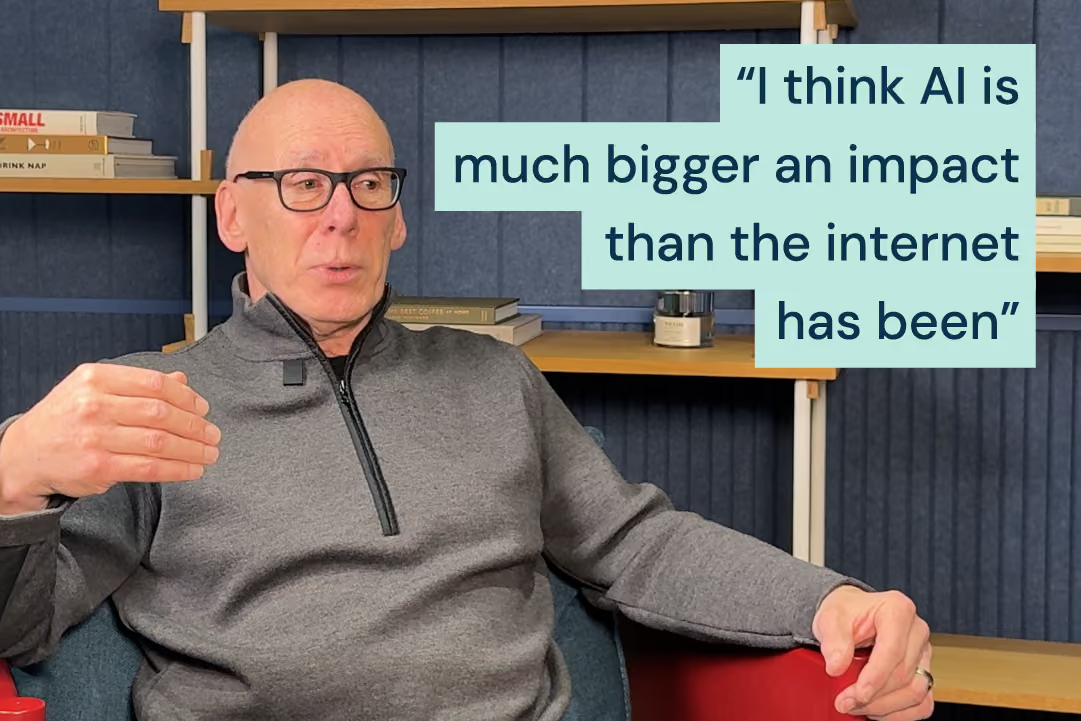

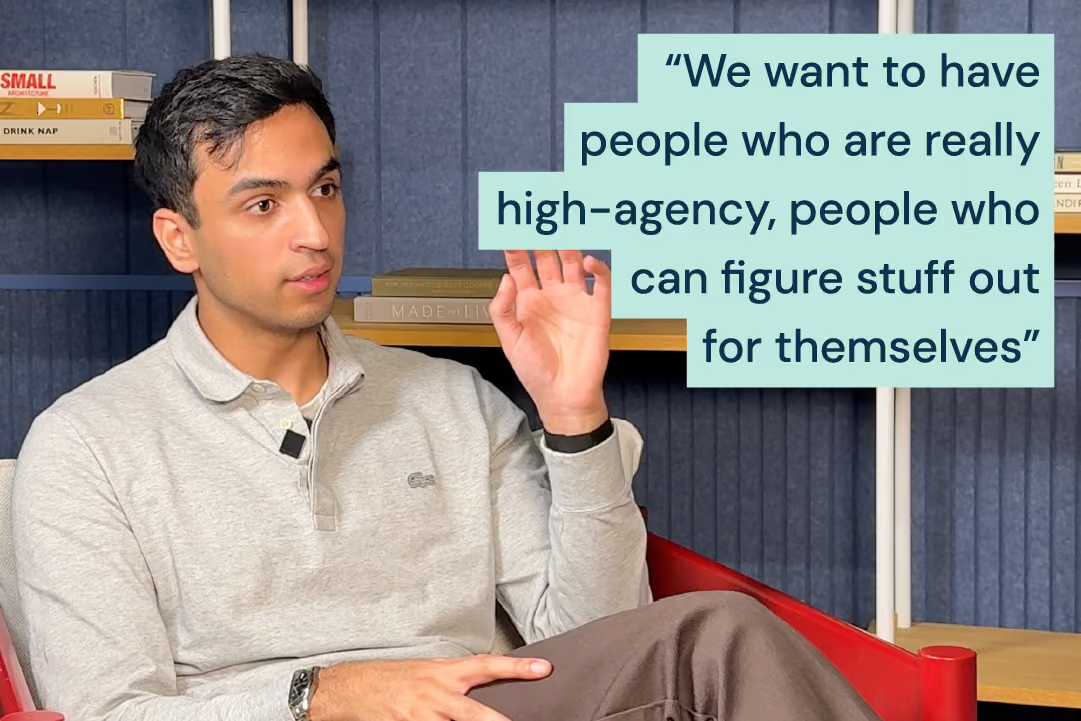
In this episode, Raghav talks about why Heidi moved away from traditional hiring rungs to find "adaptable generalists," why the NHS is a unique "clinician-led" partner for healthtech innovation, and how the practical power of sharing notes with peer AI companies at Techspace helps navigate the new frontier of technology.
Heidi is currently scaling its mission to reduce clinical burnout out of Techspace, and it’s been fascinating to see their Australian-born culture take root in London. Speaking with Raghav for this episode offered a brilliant look at how to build a team that can pivot fast and stay human in the age of AI.
Top 3 Learnings from the Episode
1. Hire for high agency and intellectual honesty
For R, the most important traits in a fast-moving startup aren't just found on a CV; they are rooted in a candidate's aptitude and values. He looks for people who can solve problems without being directed. “There's a few things: we want to have people who are really high agency, so people who can figure stuff out for themselves, they don't have to be necessarily directed. They can see problems, build a solution to solve it... You have to hire for people who can operate in that environment.”
2. Optimize for learning by pairing raw talent with seasoned operators
Rather than following a rigid corporate hierarchy, Heidi focuses on a "barbell strategy"—hiring ambitious people early in their careers who are optimizing for growth and pairing them with experts who have "been there, done that." “Our strategy is hiring folks... who [are] optimizing for learning and then pairing them with like really, really incredible seasoned operators... pairing them with people who have been there, done that in many different industries, have really low ego, who want to train the next generation.”
3. Responsibility is a retention tool
In a competitive market, Raghav argues that talented people stay when they are trusted with real impact immediately. At Heidi, "onboarding" doesn't mean waiting months to make a decision. “What surprises people about joining Heidi is the fact that you get responsibility from day one... we trust you to make this call. And like, even if you mess up, it's kind of part of the journey... we want you to mess up so then you know what to do for next time.”
Check out the full conversation below.
-----------
About The Techspace Pod
The Techspace Pod cuts through the noise to spotlight the European founders, operators, and investors building what’s next — from inside the change-making teams shaping tech in Berlin, London, and beyond.Each episode delivers sharp insight from Techspace member companies and the people redefining the ecosystem – from frontier tech and funding, to team culture and scaling strategies.
-----------
Jane: Well, why don't you introduce yourself to start off with?
Rags: Sure. So my name is Raghav, but everyone calls me Rags, I think typical Aussie thing. You get a nickname when you're young. So that's the one that seems to have stuck. And I lead Heidi across Europe. So we've got teams in the UK, France, Germany and Spain.
Jane: And what brought you from Australia to the UK? Tell me a little bit about the journey, not just of yourself but of Heidi.
Rags: Yeah, sure. So I guess to start off, I studied law and mathematics. I didn't know what I wanted to do, so I just thought I'd pick a couple of things that give me a broad base understanding of the world, and also like a really cool set of skills. Through that journey, I met a few different folks that basically convinced me to join a tech startup.
It wasn't a huge scene in Australia at the time. I mean, there was a lot of really successful companies, Canva, SafetyCulture, Dovetail, but it wasn't like, you know, what it is in the States where people are doing everything they can to join. So yeah, I worked at a few other companies and then found my way to Heidi by meeting both of the co-founders - so Tom and Waleed - thought they were incredible, very transparent founders, very, very smart. And I really liked the type of company they were building. So I joined them.
And then I mean, I guess cutting a long story short, we went through a bit of a company pivot, a really exciting one, and launched our product in a really unique product-led growth way. So like direct to clinicians. That seemed to have worked really well in Australia and we thought, why not try that model in the UK and the US? Saw a similar success, and so I was shipped off to the UK, first boots on ground to try and build a team here. And so yeah, it's been a crazy journey so far.
Jane: And how do you find the startup scene in the UK compared to Australia, now you've sort of seen it from both sides?
Rags: Very similar in some ways and very different in others.
I think similarities are that the startup scene attracts really unique, bright people. I think there's a general sense in both countries that a lot of people who are either early career or later in their career, you know, want to find something that's outside of the traditional pathways. I think very similar to here when you're in university, you think, okay, I want to be a lawyer, a consultant, a banker, whatever it might be, and it doesn't feel like there's anything else that services… maybe something that's a little bit more messy, a little bit more scrappy, a little bit riskier, and I feel that same kind of pocket that startups exist in Australia and the UK.
They're also growing really rapidly in the same way, like the startup scene in the UK is really, really exciting. It seems like it's been taking a really big swing for the better. Same in Australia. I think differences… the UK obviously has a really strong fintech focus or financial services focus. And so that's like a slight difference between the type of companies that are built in the UK versus in Oz, but on the whole a lot more similar than I originally thought.
Jane: And what was the thinking about coming to London? Why did you choose London as your kind of hub in the UK?
Rags: So it was a bit of an obvious choice. I mean, like we wanted to be in the center of everything. You want to be in a city which attracts the best talent, that serves as a hub for hopefully future expansion. Also just probably one of the best cities or if not the best city in the world, at least in my opinion. And so yeah, it was a very, very obvious choice for us to pick London. You know, we had a few options, but yeah, London was by far and away the best one.
Jane: Let's drill down a little bit into what Heidi actually does, then. You talked about how pivot pivoted, which is something that a lot of startups have to go through. You know, what you set up originally isn't necessarily what is going to be successful. So what was it in the start and what was the pivot? What is it now?
Rags: Yeah. So Heidi's on a bit of a journey. I guess the core mission has always stayed the same, that healthcare is constrained by clinical capacity or really like healthcare is constrained by human clinicians. You know, like the amount of time that you can get care delivered by a clinician is the amount of time that you can get face to face with them, or over a phone call, or whatever it might be.
And the most obvious way that's constrained is the fact that they have to spend 40 to 60% of their time doing documentation. So let's say I've just seen you, I'm a doctor, I've just seen my patient. I will then have to go up and write all of these things in my electronic patient record for billing purposes, for compliance purposes, for a range of other things. I'd have to write a letter, I'd probably have to refer you on to somebody... All of those things not only take a lot of time, it's just it is very burdensome for clinicians to do for every single one of their patients, and it takes them away from delivering patient care. I mean, the thing that we hear every single time is that clinicians go “I didn't realize I was going to medical school to write documentation as soon as I graduate”.
And so that's always been the key thing that we wanted to focus on. But the way that we did that as a company changed very radically as we progressed. So at the start, Heidi... Well, actually, at the start, Heidi was an educational tech company. We were building basically like a platform for medical students to do their OSCEs, I think. I'm not sure if it's got us here, but like basically...
Jane: That, that term.
Rags: Basically it's like the examinations that you have to do when you're a medical student, the in-person examinations. And so and it originally was building that, but then they pivoted to, I guess, a more pure healthcare focus. The original idea was to build a kind of like platform for general practitioners in Australia that would do a range of different things, but almost “Trojan Horse” AI in, because at the time, if we were going to a GP practice or a group and were trying to pitch AI to them, they would either laugh us out of the room because they're like, well, “AI is not going to do that”, or they would scream us out of a room being like, “Look, I don't get that anywhere near my clinicians, it's scary”, like just basically barber off.
And so, you know, we tried to build this platform that did a range of different things telehealth, asynchronous bookings, discharge referral letters, all those kinds of things, and then had different AI features within that to make it a bit more accessible to a clinician. We found out a couple of things. One, didn't really work in the way that we hoped even though we could sell, I guess, like top down to a clinic group and get them excited. Actually getting the clinician so you would use it was really, really tricky. And then what we also saw was that basically overnight, everyone's opinions on AI changed as soon as ChatGPT 3 came out.
So it was quite radical actually. All of a sudden all the conversations were more about, okay, can you actually get rid of everything? Just give me the AI bit. Even clinicians were a lot more excited about it. The tech was obviously a lot better. We started doing benchmarking on ChatGPT 3, and some of the internal model stuff that we'd built. We found that GPT 3 was far better than the stuff that we built internally.
And so I guess we kept on getting this constant, constant feedback from our customers and people in the market to say, “Look, it really does feel like we should go back to our roots as a more pure, AI focused company”. And so, yeah, Tom, the CEO over the Christmas break, made the decision to pivot our entire company to, again, this more pure AI focus and focusing just on the scribe aspect - so transcribing a clinical conversation. And that's where Heidi is today or that's where Heidi began on our journey.
Essentially what Heidi does is it's an AI assistant or an AI care partner for doctors. And the most common way that people use it is by transcribing their clinical conversations. So it sits in the background of a patient and doctor interaction. It listens in, it'll transcribe that and then structure that in whatever way that the doctor wants. So a clinical note or a letter or report or all the other things that they might have to create.
Jane: And it's obviously been very successful because I believe like 2 in 3 NHS clinicians are using it, is that stat correct?
Rags: Yeah. Yeah. Two in three GPs are on our platform. So yeah we've seen an incredible kind of uptake in the clinicians who are using our platform, particularly in certain segments like general practitioners, where the documentation is so acutely felt because of the number of patients that they have to see and the time in which they have to try and see them in.
Jane: And how have you found working with the NHS? I mean, we're very fond of it in the UK, but it's quite a unique beast in terms of health care around the world and also quite an old fashioned organization insofar as perhaps they don't embrace change in quite the pace that say a startup would. So how did you find having to sort of go through the motions of getting into the NHS?
Rags: Yeah, it's interesting. The NHS, it's a bit of a misnomer because really it's actually a collection of several organizations and each of them have their own appetite. I think in general, with a structure like the NHS, there's always going to be, I guess, certain challenges with getting change done, whether it's structural, whether it's due to a lack of clarity on compliance or some of the routes to actually getting clinicians to use it.
But what we found is the NHS is a very clinician-led organizational structure. So if a clinician or a set of clinicians are saying, “hey, look, I really think this is going to benefit me”, interestingly, a lot of things kind of part ways for that to happen. We haven't seen that same kind of clinician-led, kind of like from the front aspect in other markets. The UK is quite unique in that sense that they really put clinicians at the front in decision-making rather than like a business, for example, where they have a CFO making all the decisions.
And so in that way, while it is obviously tricky to get anything done in healthcare just because of how complex and unique it is, we found it actually, you know, really, really enjoyable working with the NHS because it's very much aligned to how we built our company as a clinician-led company. I mean, our CEO is a doctor, our Head of Product is a doctor, our Head of Medical Knowledge is a doctor. And so, yeah, there's this kind of natural alignment that we feel.
Jane: And you're not a doctor. So how is it kind of coming from the outside, as it were? You know, you said you studied law and maths at uni and now you're very much embedded in this medical world. How did that come about? And how does it kind of... do you think it's useful to have somebody that's sort of from the outside of that as well too?
Rags: Good question. I mean, again, it just came about because I met Tom and Waleed. I thought they were incredible founders. I also had some personal experiences, not myself, but my family going through the Australian healthcare system. And you never realize how many things there are to improve until you actually have someone going through it and you're like, oh man, there's a lot, there's a lot we can do here.
And so yeah, I guess that was like the start of my healthcare journey. I think it's a bit of both. I mean, having an outsider's perspective is really helpful in an industry where oftentimes change is enacted from within. And sometimes when you're within a system, it's hard to know what's normal, what's not normal, when to challenge the status quo or when to follow it. But at the same time being like, if you're outside of the healthcare industry, if you're not a doctor, you need to understand that you do have blind spots, you do have gaps in your understanding.
And so the very first person that I hired in the UK was a doctor. She's currently our chief medical officer in the UK. And you know, to pair, I guess, my understanding of my strengths with her strengths in understanding the healthcare system, how doctors and clinicians operate, how the NHS operates... a lot of things you can learn, especially if you're like, you know, you're willing to, I guess, be taught or you're willing to be coachable, but you're always going to have a blind spot in terms of the lived experience as a clinician. So in some ways, it's been a great thing. In other ways, it's definitely been a weakness.
Jane: And you mentioned there that you were hiring in the UK. What is it you're looking for in a team? What are the things that you go into an interview with somebody that might be joining Heidi? What are you looking for them to bring to Heidi? And what are you telling them about what Heidi can do for them?
Rags: Yeah. So it's interesting. So depending on where your company is at, you kind of look for slightly different things. I think when we first launched in the UK, we were figuring a lot of stuff out, right? There was a lot of good stuff that was happening in the market. There was a lot of momentum, but we wanted to make sure that the people we brought on to the business were very, very adaptable, like kind of generalists who could figure things out, who could do a range of different tasks, who could step outside of their traditional job description to get things done.
And then as you start to, I guess, grow as a company, you start to see patterns emerge. Then you bring on people who have a specialized skill set, so people who can do performance marketing really well, or people who can do enterprise sales really well. And so what we've seen is that while that shift has happened with our business at the moment, which is a great thing, it means that things are going well... at the same time, the core things that we look for in new hires are always the same. The way that we like to categorize it or kind of structure our thoughts is aptitude, values and then skills or experience. Because, you know, in terms of order of operation, those are the most important things to solve for.
There's a few things: we want to have people who are really high-agency, so people who can figure stuff out for themselves, they don't have to be necessarily directed. They can see problems, build a solution to solve it, and bring in people when is necessary, particularly as you're growing company so fast you can't really have a structure where you tell everyone what to do because you'll just slow everything down, basically. So you have to hire for people who can operate in that environment. Always hire people who have very high intellectual honesty, so people who are not worried to be wrong or call out someone else if they think they're wrong. Low ego is another really big thing, particularly again, as you're moving so fast as you have high agency people. If you pair that with high ego, it doesn't work well. So you have to have people who have really low ego.
And then I also look for a few things that I think are really important. Speed is one that's really important. How quickly can people make decisions and curiosity? I think if you're naturally curious, you have a lot of interests and passions. That is something that's always super important. We actually ask every candidate a question as we interview them. It's my favorite question to ask Anders, which is if you had a lecture for an hour to random group of 100 people and you didn't have much time to prepare, what would be the topic of your conversation? It doesn't have to be work related. That could be anything. And then people start to talk about all the different types of interests and passions, and it kind of gives it insight into who they are as a person. So I think that probably gives a bit of a kind of paints a picture of the type of people that we want to have in our business.
Jane: Yeah. And what have you had? What sort of answers have you had? What's your favorite answer to that question?
Rags: Favorite answer? The most memorable one was someone just because of how passionate he was, he was talking about how much he loves Chelsea Football Club. Yeah.
Jane: People get very passionate about football, right?
Rags: I mean, that was a great intro to the British culture. I think when I, when I had that answer... I mean, we've had some really, really interesting ones. We've had some about like very specific women's health issues. We've had some, yeah, a lot about sports. We've had some about, you know, like people's personal experiences and how that's changed them as a person and using that to articulate a particular journey. Yeah. It always brings out some really interesting things that you won't normally find in a traditional interview process.
Jane: So in a really competitive startup environment, how do you make sure that you retain staff and that you can upskill them and keep them at the same time?
Rags: Yeah, absolutely. Into retaining and upskilling because I think we do slightly different things for retaining staff. Again, it depends who you hire, but the talented folks that we hire really want one thing that optimizes this phase of their life for learning. And so if you're not providing them with an environment where they're learning and growing and, and able to skip some of the rungs that they would usually have to wait through in a normal corporate environment, then they will likely leave. If they're getting that, they'll be bought in, they'll love you, they'll love the business, all that kind of stuff.
It kind of goes back to what you're saying before about that kind of quid pro quo. Like as a company, you need to give your employees something and they need to give you something back, right? And so for us, it's just about making sure that we're building an environment where people feel like they can grow at the speed in which they feel comfortable, but also really, really pushes them in that sense. And so again, that's maybe like a specific thing to the types of folks that we want to attract. But really just about making sure the environment is built for them to focus on the things that they're optimizing for, which is that kind of speed of growth and learning.
I think on upskilling, it's a really interesting question because if you're hiring high agency people who are early in their career, how do they know what not to do? Basically, do they have to make all the same mistakes as everyone else? So our strategy is hiring folks... it doesn't have to be about age, but just someone who's optimizing for learning and then pairing them with like really, really incredible seasoned operators. So again, it's a bit of a barbell strategy, but pairing them with people who have been there, done that in many different industries, have really low ego who want to train the next generation.
That is how we make sure that there's a helpful kind of we're covering both bases, but also making sure that, again, it kind of ties into the retaining piece that those people can grow without just everything having to be self-directed or kind of like everything from first principles. And so it's like a very deliberate strategy that we've implemented at Heidi, and it seems to have worked well so far.
Jane: And that pairing, does that mean they could be paired with somebody that's based in a different office to them? So, you know, it's a remote pairing. It's not necessarily within the same office.
Rags: Yeah. It's traditionally paired based on the craft that they're building. So what I mean by that is let's say you're in our go to market team. So something like sales or customer success or partnerships or something. We want to hire an incredible go to market leader. And it doesn't matter where they're based because you know they'll make it work. But we want to make sure that the person that we're hiring is tied to the focus area of that particular employee.
And again, it's not like a mentorship. It's not like a formalized system where one person has one person, but it's more about the leaders of each of these different teams, and they're kind of like their direct reports have someone that they can go to to support them in all the things that they need to do. So like an example is for the UK, we have a senior advisor. His name is John. He built an incredible health care business that was based in the US and also had a really big presence in the UK and across Europe, and he's been very valuable for us to learn a lot about how you should operate in the UK, how you can grow your company, what are the things to look out for, what are the things that maybe have changed now. And so like, yeah, that's a prime example of how we've done that here.
Jane: Now, I'm guessing that your team is quite young, and Gen Z often gets a bad rap for some of the very things that you said you're looking for... resourcefulness, curiosity. Would you sort of hit back at people that criticize the younger generation for not having those qualities and say that actually, you know, you found them in abundance in your team?
Rags: That's a good question. If I'm being honest, it is definitely hit or miss. I mean, like, I think the thing that you have as a young person is you have unlimited resources, right? Or it feels like it. You have the internet, you have access to large language models, you have YouTube, you have whatever it might be. And that can, depending on the person, mean many different things. For some, that means that, you know, maybe they're not as passionate about other things because they kind of get sucked into this digital world. For others, these are tools for them to like, be truly like a polymath and learn many different things.
And so what I would say is you kind of get a range, you get a range, but it's definitely more spread to the edges. So you get people who I don't even know how they can fit in everything in their day... like they do 17 different hobbies. And it's because they use all the things at their disposal, and they just have more resources than what my parents might have had 40 or 50 years ago because of technology. Whereas you do get people on the other end that maybe aren't in the same kind of headspace. So not an invasive answer, but I'd say it depends.
Jane: It's a very diplomatic answer. But you're right. Yeah. I mean, everyone's different, right? Yeah. And I guess everyone is different in different countries as well. So how have you found that the sort of the hiring process in the different offices that you have around the world? Is every team, very different and very kind of specific to the country they're in? Or are you looking at the same thing in everybody? What are you seeing in terms of the contrast between different teams?
Rags: Yeah, I would say culture between different teams is fairly similar. And the reason why is, the people who started the US office and myself and some of the others who came from Australia side of the UK office, were culture stamped in Australian team by our founders. So you kind of are taking the culture that you've cultivated in Australia and kind of like seeding it in different areas.
So I'd say like the core traits are very, very similar in terms of like what we value as a company, who we want to hire, how we operate day to day. But there is definitely differences in how each of the countries operate and the kind of like makeup of their team. I would say I can only really speak for for our UK and European offices, but I would say the talent in the UK is incredibly high. I mean, like world class institutions, there's also a lot of appetite to make a change. I think we hear that a lot from candidates that like, I really want a job that I feel like I'm doing something good. And you do really feel that in healthcare. And so we've been able to, I think, attract some really, really talented folks.
And so we wouldn't say that that's a unique thing to the UK by any means, but it is something that I found like a really, really strong benefit to building a company in London. There's a lot of really, really smart and excited people that you can build a company around. I'd say the only difference is Australia is slightly more of an established team for us. It's bigger markets where we started, and so that operates a little bit more like a machine, whereas we're a little bit more, I guess, scrappy because we have to be in the UK, in the US or we're still trying to get to that position. But apart from that, almost very, very similar.
Jane: One of the biggest changes I've seen in employment in recent years is that people come into companies now and they sort of asking the company what the company can give them, not just the company asking what they will give to the company. So if someone were to join Heidi, you know, what would surprise them about the company? What would you tell them to basically sell or Heidi to, in a perspective employee that you like the look of?
Rags: That's a good question. I mean, look, it depends on the types of things that they care about. I would say what surprises people about joining Heidi is the fact that you get responsibility from day one. I think oftentimes when you think about joining a company, okay, I've got like a three month onboarding period and then I've got a six month training development phase where then I finally get to make some decisions. And I think the thing that you people find unique and maybe slightly surprising is you join is like, well, we trust you to make this call. And like, even if you mess up, it's kind of part of the journey... like we want you to mess up so then you know what to do for next time. And we had to catch you if you fall and all that kind of stuff.
But like it... it is a very high agency system. I'd also say again, the way that I like to sell it to people who are maybe in a phase where they want to develop as quickly as possible, is Heidi's kind of like a blank canvas... like if you join and you prove yourself and you and you do incredible things, the path will be cleared for you to really, really make a name for yourself, both within Heidi, but also within the context of the wider business in industry. That's my experience. That's the experience of a lot of people within the business that it almost feels like a build your own journey kind of thing. You don't have to go through a kind of structured, okay, get promoted every year, and then I get to the next rung and the next rung. It's truly meritocratic and you can kind of build your own path. So that's what I find most exciting. And oftentimes what I try and communicate to candidates as well.
Jane: And how linked to that sort of startup culture is having a space like Techspace? You know, what is it that being part of this community brings to Heidi and its employees?
Rags: I'd say there's like explicit stuff, and then there's implicit things or like things that you don't realize day to day until you reflect. I think explicitly it’s, you have a connection to companies that are doing very similar things to you. That's really important as a business, because particularly as an AI company, where it is kind of like a new frontier, a lot of times you... there's no clear playbook or blueprint. You can't look online and search something out and be like, this is how you build an AI company in 2026. Really, the way you do that is by being connected to other people who are doing some of the things and kind of like sharing notes and learning different things.
And so I think that's the most obvious fact that, like the people who are surrounding us are companies who are doing the same thing. And so there's just like this really explicit benefit that you get as a company for being in a space like this. Implicitly, there's just like an energy that you also get by being around companies that are doing similar things, like you hear similar conversations, you see everyone in different booths, like kind of thrashing out ideas or pitching clients, and you see them all being passionate and excited and that kind of stuff like amps off a team... particularly as you start to grow out of team, when you want to make sure that everything around that space is conducive to what you're trying to build.
So, like, we were very deliberate about the space that we wanted to build Heidi in... we're like a very, very in-office in person culture. And so doing that right was important. So it was actually... I guess responsibility from day one is like... one of the examples is we hired one of the folks who's working in the business now, Henry. And his first task on day one was: find us a new office. And so he went all around London, found different places, recorded things, FaceTimed us, and yeah, we landed on this one.
Jane: And what was it about this one that made you go. That's the one, Henry. That's the one we want.
Rags: I think there's a few things. Well, we actually came to this space when it launched for the London AI hub launch. So I think immediately it was just like, well, it just makes sense, right? Like the AI hub, we've got a lot of connections from that day. There was a lot of excitement. There's also just like a nice presence to the office. Like it's just calming. It's bright, there's big windows. Like all that stuff is really important when you're working a lot.
And I think location as well, it's central for everyone, especially as you're building our team. You don't know everyone's going to be based. So you want to make sure that it's somewhere that it's not a burden for someone to come into, particularly as we, you know, a lot of us come in every day.
Jane: Yeah, you mentioned the AI hub and what you learn from being around other AI companies. Are there specific things that you've learned that you've taken into your business?
Rags: Good question. I think one of the things that has been really helpful is there's a lot of other companies that have done... I don't know how it happened. I don't think we planned it. But there's a lot of companies that were Aussie companies or have Aussie headquarters that are in this space.
Jane: Oh really?
Rags: Yeah. And so it's been interesting to share notes on how you operate as a global company. It is tricky, right, with time zones, if you've got folks in the US, in the UK and Australia, you know how to coordinate that. Like how do they make it work? This is how we make it work. So I think that's like an explicit example of something very specific that we've got from being in a space like this. But yeah, again, we don't think we planned it, but it seems like we're all congregated around here.
Jane: I've sort of become a bit of a member of the community now, because I come in here to this lovely podcast studio, and I would say that the three things I love about this building is the comfortable chairs, the coffee. But also I discovered today they have dogs, which I found very exciting. I don't know that there are dogs...
Jane: There are dogs available... not to hire, but people bring their own dogs in and you can probably go and stroke them and hang out with them. If you were to name three things that you love about this building, can you think of three?
Rags: What would I say? I would say the phone booths. Yeah. I would say the coffee. Yeah, I'd say the coffee. And I would say the floor to ceiling windows.
Jane: Light is always good. Yeah. You mentioned about meeting fellow Aussies and fellow AI companies. Yeah. What are these sort of anecdotes that you've got from not just yourself, but from other members of Heidi that they've learned from that community or that they've kind of found out from that community? If you've got any kind of stories that you can share with us about that specifically.
Rags: I think the one that comes to mind is there's a company that's based in Techspace called Marloo. They're a company that's like Kiwi. So it's not Aussie, but they're from New Zealand and backed by the same fund. So Blackbird actually AE is an angel investor in Marloo as well. And they are doing something very similar to us in terms of product but in a very different industry... for financial advisors.
And again, that's a very explicit example of how we've been able to learn from each other because they look at our product and see what's applicable to theirs, and we look at their product to see, oh, wow, that's a really interesting implementation or manifestation of that idea. We should feed that back into our product team. And so we actually had them in our office for a couple of days... like they kind of had a desk in or like a table in our office. And, you know, just sharing some of those ideas with them on a very specific product basis, getting our product managers involved. That's been something that's been... again, not not in this kind of airy fairy... "It's been great to be in this space." Like there's a very specific example that I can that I can point to where hopefully we've helped them on the product side and they've helped us as well.
Jane: So with Marloo, tell me a little bit about how you kind of went about setting that up. It's quite a brave thing to do, isn't it? And also what you learned from the experience.
Rags: Yeah. So with Marloo... actually forgot who made the connection. But again, I think it was one of the... you meet someone who meet someone who met someone. And I think one day I got a WhatsApp from a friend who said, "Hey, you should really meet Marloo. They're doing something quite similar to what you guys are doing a few years ago, and it'd be great for you guys to be connected, to learn from each other." And we've always kept close to their founding team. Then we didn't know this, but we ran into them in the office. I think they were on level one. We were on level three and we were walking out... like, "Oh, I didn't know you guys were based here." Again, we just would be catching up after work or just seeing each other around. We'd see them kind of in booths or in the open space, talking to customers or thrashing out ideas together.
And they, they were actually the ones who suggested it, they were like, "Hey, would it be possible if... we've got three folks at the moment, like, we'd just come into your office and work from there for a bit?" And felt like a no brainer. I mean, like, we've got a friendly team. They have a really friendly team as well. There was a lot of overlap in what we were doing, and so maybe it feels a bit like a brave thing, but we didn't actually think about it too much. They just suggested and we said, "Sure, come by." So next day they came by and worked from office.
Jane: And what did you... what was the big learning from it? Was there one thing that you kind of got out of it? Was it a specific thing? Was it just a general kind of feeling that this was a good idea?
Rags: I think apart from the kind of very specific product learnings that we got out of it, I think the key thing that was really exciting was how excited each of our teams were about the different things that they were building. Like we were genuinely... even though they were not focused on healthcare, there was a genuine interest in the things they were doing, and the fact that each team wanted to be helpful to each other. So I think I guess the key thing is there's a lot of this like latent appetite for companies to mingle and interact, even if they're not from the exact same vertical, the exact same industry, which I think we should do a bit more of.
Jane: That's really interesting. We've got a new thing where we're asking people... I don't know if you have... you don't warn your employees when you throw your question at them. So my throwing at you question is what have you kind of come across... and it can be... it could be something that you've learned from being in this community. It could be a book, it could be a film, it could be a post you've read on LinkedIn, something that you've come across that you want to share and pass on. Because the point of this podcast is to pass on information. So what have you found in the in recent days that's really excited you that you'd like to share with with the rest of the community? It could be about anything.
Rags: Anything?
Jane: Anything.
Rags: ...
Jane: And you can think about it... we can give you thinking time.
Rags: I mean, the one that I always, always recommend to people is a speech called "This Is Water" by David Foster Wallace. So it was like a commencement speech, maybe in the mid 2000, 2005, 2006. It's on YouTube, Spotify, whatever. I listen to it every three months. I think it's really valuable presentation. I don't want to speak too much about it because I'm definitely going to paraphrase it poorly, but, yeah, I'll tell you for people to check that one out.
Jane: Good. I'm going to go and do that now for sure. I like the fact you didn't tell us anything about it as well, because now we have to... Thank you so much. It was lovely to speak to you. Thanks for joining us in the Techspace podcast Studio.
Rags: No worries. Thanks so much for having me.