
Top 3 Learnings from the Episode
1. Treat failure as a milestone, not a mistake
For Mel, building a successful culture means removing the stigma from technical dead-ends. At King, they celebrated the decision to kill projects that weren't working to ensure the team felt empowered to move on to the next big thing. “They actually applauded the failure because we tried to do something that just didn't actually work the way we thought... we actually have a party to celebrate that we're going to kill off a game that would never see the light of day.”
2. The "Technical Moat" is disappearing in the age of AI
The barrier to entry for building software is dropping rapidly, meaning companies can no longer rely solely on the complexity of their code as a competitive advantage. Mel warns that applications that once took years to build can now be replicated in weeks. “The technical moat that we always used to look for is becoming harder and harder to defend... the application can be replicated so quickly nowadays, it's a massive, massive disruption and transformation.”
3. Move from "Search" to "Verified Research"
While frontier models are impressive, Mel highlights their struggle with accuracy and source attribution. His current mission with Corpora is to provide professionals with deep-dive data that is fully validated. “Models are very good at giving you a pretty good view of a topic... they're not so good at being able to tell you where that view came from. So what we provide... gives you full attribution of exactly where that information came from.”
Check out the full conversation below.
--------------------------------
Jane:
Okay. Well, first of all, do you want to introduce yourself?
Mel Morris:
So I'm Mel Morris. I'm the CEO of Corpora AI.
Jane:
Now, before we talk about Corpora, I want to talk about some of the things you've done in your past. You've had an interesting life. There's been a lot of things going on. Let's start with your name as the Candy Crush King. What's that all about? And how did that sort of get you started in the world of tech? What did you learn from being in the gaming world?
Mel Morris:
Well, I'll probably take exception at the title on the basis that I think there's probably about 20 people in front of me that would probably rightly deserve that title. Started with the CEO, Riccardo Zacconi, but also the co-founder as well as his Toby Rowland. And then there's a whole raft of others that probably mentioned as well in that list.
But I was involved. I was part of the journey from pretty much, inception, the seed financing of it all the way through to it going public on the New York Stock Exchange.
Jane:
And what did you kind of learn about, backing a company and selling a company that sort of carried on through your entrepreneurial journey?
Mel Morris:
I mean, interesting. King was a really, really valuable experience in so many ways. It wasn't the overnight success that people perceive it to be. You know, the business started, 2003. Of course, went public in 2014. So 11 years in the making and, in the early days, no one wanted to back it.
You know, in fact, I should provide the seed capital because we tried to raise venture capital funds and couldn't do so. No one wanted to know. And so the first lesson was that even when you think you've got something everyone inside thinks is a great idea. Convincing people in the outside to back it is a whole different game.
And so, started really with understanding that even with good people and what looks like a good idea, we were probably ahead of the times like that makes it very difficult. Venture capitalists tend to follow fashion. So if you're pioneering in something, it's a dangerous place to be to raise money.
Jane:
And what about dating apps? That's another thing you've been involved in that's evolved a lot over the years. What are you seeing as the key differences, and what was your experience of being in that market?
Mel Morris:
Well, that's that was a bloody nose in some ways. What was a success was quite interesting. So we set out, to build a business. My co-founder general called Howard Packer. He wanted to start a conventional dating agency, and I know will appetite for that. But the internet was just starting to really take off.
And what did we do on the internet instead? And, we built the business, had finance lined up, and, basically our plans got crushed when the market went completely pop. And we were scrambling around to try and find investment. We eventually, did a reverse take over the an OTC bulletin board stock in the states on Nasdaq. Raising just $7.5 million, which sounds like a lot, but our contemporaries had raised two and 300 million. So you can imagine we were the least capitalized of all of them. But our business was better.
You know, we were the first ones to be introduced to a matching. So, it was a day to play more than anything else. And the concept was, you know, if you walk into a bar, someone might catch your eye, but it's rather special when that person also the coach there. Right as well. So our view was that we couldn't just leave it there. You could say what you wanted. We would only introduce you to people that wanted to see someone like you as well.
And that made it far more selective, far more successful. But to get around the fact we had less money than other people, we needed an edge. So we followed the age old to cocktail bar syndrome of the drinks of a certain time. But in that stage we said women were free. That might not go down quite so well today.
All right. But it worked really well for us because a side had two thirds women, one third of men. Most of us were two thirds men wanted women. So it didn't take long before we started to attract a large number of males that wanted to pay to meet these women that were available. So that was interesting. We went then, having built the business that a very successful business model.
We did enough scale. We were running out of money very quickly. We chose to buy another business that had far more users than we had, but that actually also didn't have quite a successful business model as ours. We moved two businesses, both losing about a quarter million a month, and within 2 or 3 months of merging the two, we were producing half a million of profit a month more. Pretty interesting.
Jane:
It's been an interesting journey for you. You must have seen a lot of changes in the world of technology. What are the sort of things that you've witnessed in technology that have most surprised you over the decades?
Mel Morris:
I think that often people are surprised by changes in tech. And yet many of them are actually predictable. And people are just a little bit too reticent to embrace those changes. So I can take you right back to the 70s and 80s. At that time, hardware was king. Mainframe computers, IBM, ICL and, people thought they were never going to be replaced.
And many computers came along digital equipment, Hewlett Packard, Siemens next door and several of this, Data General and that started to erode the mainframe marketplace. There were more accessible, cheaper for companies to buy, easier to work with. And yet at that time, Hollywood was still king.
So you have people, visionary people like so many ICL data skill who said, you know, we should give the hardware away and just charge for the software. And of course, that's what became SAS eventually is almost that model. The whole would be in the cloud. We wouldn't think about choice for the services. So that happened.
And then of course, the minicomputer that gave way then to the PC that started to to really cause another big shift. Now we're bringing computing to the desktop. And then you see the likes of Steve Jobs coming around. And he then introduces us to the tablet, to iPhones, to iPods.
We all remember the first iPods coming out, and we've now got a music library on a small device like this, and it's really high quality. And if we saw the change that was going to happen in how people interact with that. So visionaries often see these changes coming way ahead of the rest, and it's often far too long for the private equity and the venture capital market to catch up with that change.
And they tend to be over investing after the change has already been seen. So they come in late, they invest too long, and there's some lessons to be learned from that. But as we see technology today, we will see AI and thinking, well, what a transformation this is. I don't think we've ever seen something probably since the dawn of the internet.
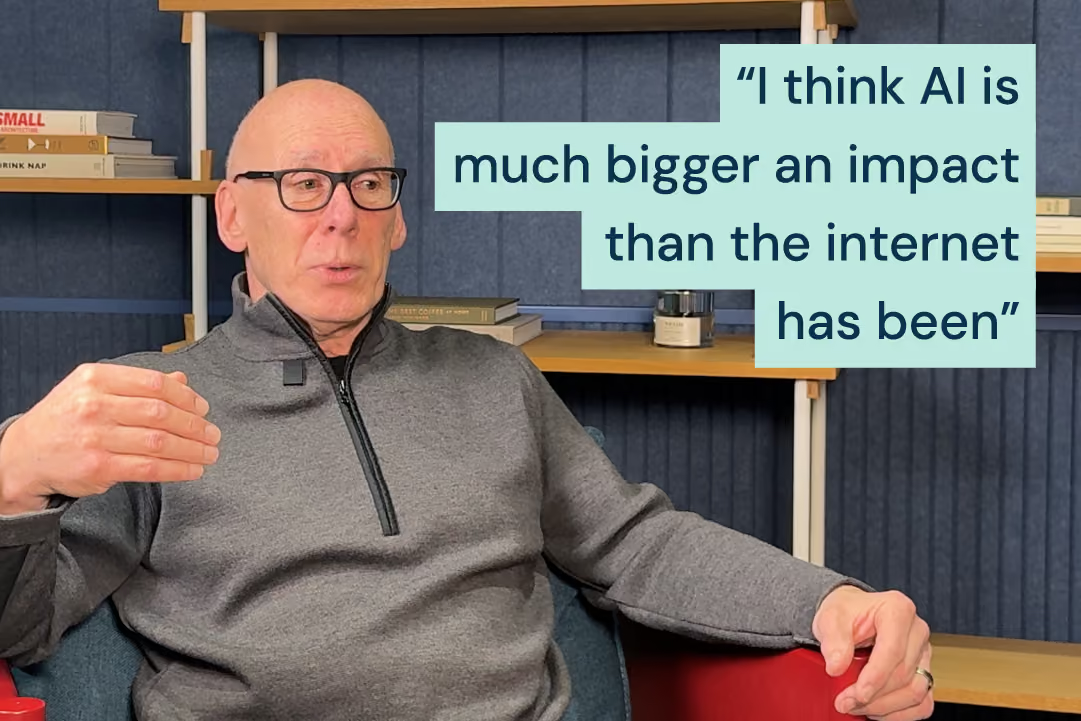
I don't mean this. I don't mean to disrespect this in Sir Tim Berners-Lee on this, but people see the internet really as being probably a 90s thing forward. When will you start? Much earlier than that? But the internet was probably the last big shift we've seen prior to AI. And I think AI is much bigger as an impact than the internet has been.
Jane:
And let's talk a little bit about the impact that you see that having. But first of all, you talked about disruption and, you know, hardware, software coming along and everything going on to the phone. What did you think in that moment in November 2022, when ChatGPT was launched, it surprised everybody, not just kind of members of the public, but people that were deep in technology. Did it surprise you and what were your thoughts about it?
Mel Morris:
Well, you know, it probably goes way before then. And not to, you know, sort of take the shine out of the light of open AI and ChatGPT. But all that came from a seminal paper in Google, which is a paper called Attention is All You Need. And there were 4 or 5, four, four folders of that document, the start of what was called Transformers.
So before we get to open AI and what it did, you have to roll the clock back. You know, so people like Leon and Yann LeCun and people like this would be involved in that process. So we'd seen that coming around. The impressive it was we could see that. But I suppose what happened was that open AI made it Vogue.
They brought it in a form that pushed it on the people's noses. They could use it. It was impressive. But I remember seeing the announcement of that, and I said to my team, the world is going to change because of this. I thought it was premature. I think the technology could have been, I say, more finessed when they launched it, but that's often the case with American companies that they want to get the products out quickly, which is probably the right thing to do.
And they really still will lead on the marketplace by doing that. It caught Google by surprise. It caught Microsoft by surprise. So, you know, credit to Sam Altman and the team in that regard. But of course there's also other people like Elon Musk that was involved in that journey as well. So there's a lot of people that when you look around, it wasn't just ChatGPT.
It wasn't just OpenAI. There was a lot of other things that led to that, that were going on at the time. And, you know, we shouldn't take the shine away from the efforts of those people. If it hadn't been for that original seminal paper and the work Google did, OpenAI would not be.
Jane:
It's ironic, then, that it wasn't Google that stole that much. It was a different company. And I guess somebody had to sort of, let the dog out of the traps, as it were. We saw Google catching up with Bard and now Gemini. Do you still fear that this stuff is going too fast, that the that we're kind of rolling this, this technology out before it's quite ready for the world?
Mel Morris:
No, I think was I think the word ChatGPT was, was in my opinion, premature. From marketing perspective, it was perfect, perfect timing. But from a function perspective, it had enough rough edges to bring out a level of doubt about the technology that I don't think the technology deserved.
It has been pushed ahead of its time. It wasn't finished enough. More reinforcement. Human learning behavior need to be done with it to get it under control. I think we're still at a stage now where we're almost looking at it with, I suppose, almost critical eyes about some of the things it does badly that it's taking away the view of what it does.
It is exceptional. And I think it's not been until the last, I think the last three, four, five, six months since we've seen the models of GPT 5.3 coming out, Gemini three coming out clothed with Opus 4.5 and 4.6. And these have been what seem like incremental steps. But it's a bit like trying to get an engine to work.
Sometimes it doesn't work at all, and it could be a little thing like maybe the ignition timing was the way the fuel injection works or some other component. You get it right and you're winning formula one races with it. And so these final pieces, as much as they seem like small steps, have a massive impact on the application of this technology.
So if we look today at the capabilities of these frontier models, now Gemini three, you know, OpenAI, the GPT 5.3, Claude and anthropic with Claude and Opus 4.6. They are in a different class to what GPT three was. Their capabilities are off the charts, and yet we're still looking at them with these AIS of these are things that they run.
These models do much, much more that they do really well incorrectly than they ever get wrong. And the whole concept of vibe coding on the back of these technologies is going to transform. It's going to obliterate many companies. It's going to transform what we do. It's going to introduce a whole new raft of application development. And the disruption it's going to cause is going to be massive. If you want, I'll give you examples of it.
Jane:
Do. Yes. I mean, every time you speak to somebody, they talk about jobs. First of all, is that where you see the disruption coming? The jobs are all used to doing well. Some become obsolete.
Mel Morris:
It's interesting. I mean, I was talking to one of my advisors and close friends about to see the day, and, there's a famous story I probably won't paraphrase it perfectly, but I'll try and give you the message. Says, well, let's talk about AI being a, a digger, a bulldozer, an excavator machine, a Bamford machine, a let's call it bridges, a JCB digger.
And some would say, well, isn't this going to put a lot of people on the jobs digging holes? Yeah, well you're right, we could have. We could have used 100 men to dig this hole with a spade. But you could also say we could have taken a thousand men with a teaspoon to do it.
So we've seen lots of things that talk about replacing humans in different forms and guises and, and we've survived most of those and we've readjusted what we do. So there is going to be casualties, but it goes far more reaching than that. Let's give you a good example. So recently, anthropic launched opus 4.6.
They've now put out basically and a genetic solution that's helping lawyers now with their legal work so we could look forward and say what lawyers do is quite programmatic. If you look at what they try to do a lot of skill, but programmatic skills as well.
So we could see a scenario where lawyers could find that firms manage with far less people less. I sound like, what happens then? So let's say we go 1000ft in. Is in the business fairly large, you know, UK law firm. We can bring in this AI process to replace some of them.
So let's say we get rid of 200 people. What happens. Well all of a sudden now we've got an absolutely a load of lawyers out of work. So what do you think happens to the salaries of those left behind? Supply and demand says actually, not only do we lose 200 people, but the salaries that we currently paying for people will also reduce because we can now hire new people for less money, because there's 200 out of work wanting to work for whatever price.
So there's going to be a massive adjustment in these things. But let's also step back. How many people were a year or two ago, the season people saying it's all about the application of AI. We should be doing agent things. Businesses started to be built using agent processes.
But meanwhile the frontier model providers, the Googles, the only AIS, the anthropic are weren't earning enough revenue. So, well, if we could let some of our clients build these applications, we could build them ourselves.
So now you've got the likes of anthropic will now be putting out a whole raft of businesses that were looking to do legal applications using AI. And now you've got the master of AI and anthropic now taking them on to do it themselves. And we're going to see more of that because they're they're quest for revenue, meaningful revenue.
The model being the source of revenue has ceased to become the powerhouse that we thought it would be. We almost commoditized the cost of AI. How did you get around that? Well, you build the application. Well, why should we let other people do that?
We do ourselves, and now we as anthropic or as I'm the I was Google can now offer these high value services, but it puts a whole raft of other businesses at risk in doing that. So the disruption is on many different levels. All right. And it's not always let's say pro growth for startups and those things.
And what all sounds is now the amount of money going into these big companies to finance equipment. I'll give you an example. And it's one that people should reflect on. We bought two new service to support our application. I think it's really super efficient.
We don't need to use GPUs on it. We bought two servers cost just under 400,000 pounds. That was back in September. We look towards a two more service of that in January this year. What price you think? There were 1.7 million 400,000 for the same spec to go to 1.7 million.
That was cool was because the demand caused by these big companies building these super data centers creates a supply and demand issue, and it comes down to the cost of memory. And so high speed, high value memory is going through the roof. It's affecting every sort of form of use of technology, and UPS will be the people who pay the price for that, because they can't afford to compete to that level.
Jane:
So what can you do about that? You know, if the corporate world and these big tech giants are in control of these technologies, and everything is being pushed for, for their agendas, how can we change that?
Mel Morris:
Well, you have to be differentiated. You've got to find those niches. You've got to be able to be clever and looking where the market's going. And you know, you can't afford we buy our own equipment. And I'm fortunate position to be able to do that. But other people be forced into the cloud.
But it won't be long before the price of hardware affects the price of cloud computing as well. It'll follow the same trend. Now, it might come down again in the next couple of years, but in the short term it's putting a squeeze on things. So, you know, going beyond talk to Google, go and talk to AWS.
Go and talk to these providers. They all have a start up programs. Get in there as quick as you can. They'll offer sometimes 100,000 200,000 credits. Use that money wisely to debug your application on their platforms. All right then you're insulated. At least for that initial phase, you get your proof of concept done before you need to go and raise money, and you never know. You might find also the price break for those vendors doing it, but it's all about differentiation, adding real value.
Jane:
So talking about differentiation, let's talk about what Corpora AI offers. What is it that you are bringing to the AI market that, is different from what the big tech giants are doing?
Mel Morris:
Well, in the Google? You know, we can talk about open AI, we can do anthropic. They're all frontier model providers. They do more than that. But but that's what they produce. We've we've gone a slightly different way around this thing.
So models are very good at giving you, a pretty good view of a topic. They can describe it pretty well. They're not so good at being able to tell you where that view came from. Okay. So what we provide, if we provide the ability to map an absolutely mountain of data and be able to fuze that with AI.
So you can now get information back from the combined process Corpora, which gives you full attribution of exactly where that information came from. And then we've got a whole raft of other things that can do as well. So we can do things from we can tell you what's wrong with the process.
We can tell you how to come up with an idea to solve that process. We can then validate that idea. And whereas a model might give you maybe three or 4 or 20 manufactured citations or Google databases might give you 200. I did one report for someone this morning to less than three minutes.
It idiot to a process. It second guessed it. It was over 17,000 documents to do the validation that was cited to prove it. Good work and we do that in minutes. And we can also do this. I can actually do on my laptop. I actually got a GPU on my laptop.
I can do all of this without having to send my information out to the cloud. I'm going to expose my intellectual property in doing that, so we can give people ownership of their own data, their own ideas, their own concepts, without having to share it across the internet with it, with a public use model.
Jane:
I mean, who do you envisage being the customers or who? All the customers of the system.
Mel Morris:
So our customers are people who want to push the frontiers. You could call them mavericks. And I mean, that's a real compliment. I people really want to change the way things are approached. Novel ideas, new, new ways of approaching a particular problem.
So examples are at the moment go from how we make, the use of solar energy for more efficient is one of those. The other one we're looking at is how to actually make the process of hemodialysis kidney treatment to be physiologically harmless, whereas today's process has been around for decades and causes massive strain on the body.
So we fix one issue. We're helping to, if you like, supplant what the kidneys are doing but actually will complement those. But it's also putting strain on the heart. It's putting strain on the cardiovascular system causes problems with the brain and other things with that.
So we've been using this system to be able to help a business to now look at how you can actually produce a new way to do hemodialysis that is physiologically transparent to the body, that they're just examples. And there's lots of of this as well.
Jane:
And how important is it to be part of the AI hub which exists in this building, which tries to unite a lot of the growing community of AI companies out there? Tell me a bit about your role in it and what you see as being its real benefit to you.
Mel Morris:
Well, I think it's fantastic. And, you know, a knowledge sign. I think that when you bring together a number of businesses, a number of entrepreneurs, a number of technical people, a lot of marketing people who are facing similar challenges. Going back to what we said about how do you survive in this myriad of disruption going on out there?
This is a real powerhouse of doing that. So last week, we had the opportunity to present to 60 civil servants, along with nine other businesses. And I said to my team, I said, I want to go and listen to all the other pitches because you learn from what they're doing, the way they're presenting, how they're challenging things, the problems that they're actually finding that they're coming up against.
So to to hear those things, then to have a chance to chat about later is fantastic. By the way. We had a great slot. We had the slot just before lunch, so it's much easier to get people coming to talk to you after that slot than if you're the first one in the morning. I've got to wait till lunchtime, but it was fantastic and I think the people here are really helpful.
You know, I think, you know, he's saying, Rupert, these guys really we put all the soul into it. So otherwise anyone who's thinking of having a base in London, this is a great place to start. And it's economic to do so as well.
Jane:
And it's that sense of community. Does it go wider than just, having like minded people in there, things that you can learn from other AI companies, practical examples perhaps, that you've got of where you've done that, that kind of help feed the work that you're doing it.
Mel Morris:
Without a shadow of a doubt. And, you know, you've just talked a bit about technical problems. You told me about marketing issues, maybe just a bit of camaraderie or just the fact that someone else is facing a similar issue. So you're not alone in being alone there. They're all really fantastic parts of that. And yeah, there is a community and there's lots of chance to to also socialize around that, which can also be helpful as well. Contacts. And those are the things with it.
Jane:
And how important is culture as well. Because, you know, you've you've seen a lot of companies, you've brought a lot of companies up. You've you've seen how entrepreneurship works at the coalface. What have you learned in terms of, of of of office culture or work culture that you would want to pass on to others?
Mel Morris:
Well, it's interesting, I was I was meeting with a potential client about this morning and, they've got an application that's targeting exactly that sort of question inside organizations. It firstly, many organizations couldn't even define what their culture is. Okay. So I start there.
And I think that's that's a really important statement because people just find it evolves. But if they're asked to think about it, then they will learn a lot about just stating what it is. So, so starting with a call to an I'll call it tone at the top, and how that flows through becomes more and more important, particularly as you grow.
And then we go back to King here because what we kind of built there, what Stefan Kagan and the guys at Bilton and Sebastian, the other guys in the business, that bill was a really fabulous culture. One of the things I remember really well, which is a great lesson, was the not not to actually look upon failure in tech development as being a problem.
It's a natural part of trying to do new development. Not everything you try works, and if you treat everything as a failure, you condemn the people who worked on it to be a failure as well. So they they actually applauded the failure because we tried to do something that just didn't actually work the way we thought.
So we just move on with that team on to another thing. So we actually have a party to celebrate that we're going to kill off a, a game that would never see the light of day. That was a cultural thing. And to maintain that culture, we went from having about 100 employees to suddenly employing 30 to 40 a month.
Well, you roll that forward in three months. Most of the people hiring people, I've only been here 2 or 3 months. And at that point, if you haven't got your culture defined, if you don't know what it is, but it's not evident if people understand it, your culture now is actually being hijacked by people coming on you, not because they want to change you, but naturally you're importing different culture coming in.
And that's that was a real lesson with that, that, that you could see happening. And they were really good at managing that process. So credit to the guys for it.
Jane:
So now when you're looking to sort of get new employees at Corpora, what is it that you're looking at out for? In essence, what are the sort of the qualities that you look for in an employee and what kind of makes you think, right. Yeah, that they're right for me.
Mel Morris:
Well, we're a tech business, so so it's a very different answer that it might be, let's say if we were a service organization or we were a medical organization or a tech business, we have to be entrepreneurial. All right. That that's number one.
Secondly, you know, the last night I had a conversation with one of my staff members, a really good guy doing this, and he hated development. He now loves it. I said to I said, you know, Charlie, please don't ask permission to go and do that. Just go and do it.
Just go and do it. All right? Follow your gut. Be empowered to get on with it. See where it takes you. If it doesn't work, we'll figure that out down the road. But I don't want you to feel you've got to look over your shoulder asking for permission to do things.
You know you've got enough skill now to get on, get that done. And so we want our people to be to a degree, maverick, to a degree, to not accept that everything that everyone else thinks we should do is what should be done.
Sometimes it's quicker to test things and to debate them and so sometimes will agree for two different people to go down different paths for the same thing, just because it's quicker than having a debate that drags on for 2 or 3 days, or weeks or whatever. Get on, try it. We'll see when you built it. And let's have a look.
Jane:
What lessons he learned from being involved in top level sport that you can bring to the the world of tech.
Mel Morris:
Is completely different. It's completely different. It really is. And you know that organizationally it's different, you know, so so you've actually got a structure which is very much sort of almost like that, that the empowerment that is given to the manager, right, is almost devoid to a degree of what happens at that, at that.
So sea level inside the business and has to be that way. So it's very different. And but what you do see is the things that it's very much more a team oriented thing. Managing the team oriented aspects of that is far more challenging.
You know, there's far more there's a smaller group, so it's always a smaller business in that regard, at least from the playing side of the house. But I've also learned a lot from sponsoring a lot of individual sports people as well.
I think that's probably a good balance, because when you've got individual sports, but also I've got a young lady at the moment actually in the Winter Olympics for for the UK. All right. She's a skeleton bobsledder. Wow. Okay. I've never I've ever seen these things, but it's a basically a piece of metal as well with carbon fiber whatever.
That's around about half a half a meter square, a few sort of runners on the bottom of that, and they hurtle down these things that nearly 90 miles an hour. All right. And, we've been backing her since she was about 18. All right. And she is absolutely phenomenal.
I said to, if I was your father, you wouldn't be doing it. It's like, oh my goodness. It's like, we we love watching on this, but it's scary stuff. Now, she has probably been the one who's asked for the least amount of financial backing and the amount of focus.
But the determination, the commitment has been absolutely unbelievable. Another one who's actually, again, a figure skater who's, also representing the UK and, you know, she's had the pleasure of working with both cousins and so on and so forth in that league.
And she's pretty we've been back in her since she was early school age, but she was having to get up at five in the morning with her mum before she went to school to go and get on the ice rink. Wise, quiet to be able to go and do things and that commitment with no guarantee is going to succeed.
So and at first we thought, is it the mum that needs to do this? But now she embraced it and it's, it's that doggedness to want to keep going at it. That challenge through got golfers. We've got other people again that we sponsored in the same sort of way. And you learn a lot from the homework. There's no no secret homework is a massive part of it.
Jane:
And how your Winter Olympians getting on in the current game. Yeah.
Mel Morris:
Well, you know, so so so Freya God bless her. She she she didn't get the number one slot to be able to go this year. But, it's interesting because we asked the one a couple of years ago, what's holding you back so well, you know, you get handed down the runners when you're not the number one.
So I said, what do you mean, you've got to say Non-runner said, no, no, no, we'll we'll just buy a set of runners this five, five grand or so. It's not a lot of money in this scheme for it. So but she's doing, doing really, really well. So, and so proud of it. So proud of that.
Jane:
The other thing that I guess football and tech have in common is that, you know, in the course of a week, things can change dramatically depending on on how games go, how, tech develops. And I read that, you ask your team to think in two week cycles. Tell me a little bit about about that.
Mel Morris:
Well, you know, it's fast moving. And I think even two weeks now sometimes could be too long. But, you know, the difference that these frontier models are making up is 4.6 GPD, 5.3 Gemini three.
I keep calling them out because if you're using something where the numbers are less than the numbers I've just quoted, you're not using the latest stuff and it's really important. So what Claude have done, what I, what anthropic have done with Claude.
What Gemini three is now open 5.3 is that this whole concept of vibe coding is taking things to a new level. So it is possible to build an entire applications in an hour. All right. Now we can argue about the merits of some of the code of that whatever.
But the ideation of these things is unbelievable. So now imagine that you're about to buy a business. And that business, let's say, has got a turnover, say 10 million. And it's got a software application that they tell you is absolutely unique. All right. And there's the powerhouse behind that 10 million of revenue.
And you sit down with your due diligence team and said how long would it take to build that application. Well, they spent two and a half years with 50 people. We could do it in a month. What would you pay for that business?
Because what you're buying is the revenue. You're not necessarily buying the application because you could develop that quickly and easily. So the impact of this stuff now is that the technical moat that we always used to look for is becoming harder and harder to defend, and that's going to be a massive transformation in the value business.
We saw the value of SaaS businesses when anthropic launched this stuff on 4.6 a week or so, about $1 trillion went off the stock market in a week, $1 trillion. And that's going to affect the price of companies, how they're valued, right.
What they think is their strength and their moats and their ability to defend their position. Those are all going to be not under attack. They're all going to become all lost, short lived. All right. If someone wants to go and compete.
So that the business base, the momentum has value, the application has value, but the application can be replicated so quickly. Nowadays it's it's a massive, massive, you know, disruption and transformation.
Jane:
And because of that disruption is almost impossible to, think future gazing, look at what's coming next. But it's there's one thing there's no question about that. All these big tech companies are very focused on, artificial general intelligence, AGI and their timeframes for when that may arrive. Although obviously it's not just going to sort of suddenly land out of nowhere, but have gone from decades to, you know, maybe in the next five years. What's your definition of what AGI is? First of all, because it means different things to different people. Right? And you know, what's your time frame full of.
Mel Morris:
The timing of it, I think I think Sam said it was going to be a year away. Sam. Yeah, yeah, about a year, 18 months back and we're still at least a year away, if not more. So I think it's one of those things that that is going to be something that may emerge and then will be questioned the same way that GPT three was, was, was questioned.
So I think actually thinking we have arrived there and proving we have arrived, there will be two different things. Right? And I don't think we should worry too much about waiting for that, that that's something the markets and things like that might want to pontificate on.
Like, let's not lose sight of what the value is of what we built today and how we can utilize that. So I think the whole AGI thing, I think to the average person on the street is probably not that significant. It's a it's a badge of honor that will cause a company to go from worth $1 billion to $1 trillion overnight.
And then we'll figure out, well, what is it doing that we can't do? What do you do with a genetic AI and other things today? So I'm not living in hope or fear or waiting for that that moment. I think I'm rejoicing on what we have today and how much we can leverage that to do really wonderful things.
Jane:
That's a very sensible way to look at it. Now, we did thrust a question on people that they might not expect, but, let's see where we go with it, because the whole point of this podcast is kind of pass on information to share, to educate. What have you seen, whether it be a book, a speech, a, a post on LinkedIn, a conversation, you come up with somebody that has inspired you personally in recent days that you'd like to share with the audience.
Mel Morris:
In recent days and also recent years and probably a decade or so in this one. But we're talking about a two week horizon for thinking in terms of moving forward. And, and it brings to mind a very good author, on the topic of change. Okay. And it's a general called JP John Cotter.
And John Cotter has a number of articles and YouTube videos where he talks about the impact of change in today's world. And he goes something like this. The rate of change is accelerating. Entropy always goes up, it never goes down. And because of that, we have to have a sense of urgency.
So we have to be urgent about what we do well. Think about where we go, what we do things. And I think that so to my mind, John Carter will be one of the key elements. The other ones I think will be Steve Jobs. And again, may not be recent, but actually look at some of the videos there is relevant today as they were back in the 80s and 90s about the visionary side of what this means, how it will transform lives.
Jane:
Thank you so much for joining us on the Techspace podcast. It's lovely to talk to you.
Mel Morris:
It's been a lot of fun. Thank you.


.avif)
%20(6).avif)
%20(8).avif)